

The idea that a hard mattress is good for back pain has been around for a long time. Generations of people have slept on boards, on the floor, or on the firmest mattress they could find because they were told their back needed it. The reality is more nuanced than that, and for many people with back pain, a very hard mattress is not the right choice at all.
This article looks at what the evidence actually suggests, who does benefit from a firmer sleep surface, and how to approach the firmness question honestly.
Where the Hard Mattress Idea Comes From
The advice to sleep on a firm or hard mattress has been passed down through generations and was at one point endorsed by some medical practitioners. The reasoning was that a firm surface prevents the spine from sagging out of alignment.
The problem with very firm or hard surfaces is that they do not account for the actual shape of the body. The human spine is not flat. It has curves. A perfectly rigid sleeping surface cannot accommodate those curves. The result is that the shoulders and hips are held at the surface while the waist and lower back are left unsupported in the space between. For most people, this creates its own form of back strain.
What Research Actually Suggests
Research on mattress firmness and back pain, while not definitive, generally points away from very firm mattresses as the universal solution. A widely cited study on back pain patients found that those sleeping on a medium-firm mattress reported less pain and disability over time compared to those sleeping on a firm mattress.
Medium-firm, in this context, means a surface with enough give to accommodate the natural curves of the spine without allowing the body to sink so far that alignment is lost. That is a specific quality, not just a label on a product.
Who Does Benefit From Firmer Surfaces
Stomach sleepers generally do better on firmer mattresses. In this sleeping position, the pelvis tends to sink into a soft mattress and exaggerate the curve of the lower back. A firmer surface resists that sinkage and keeps the spine closer to neutral. Stomach sleeping is not ideal for back pain in any case, but a firmer mattress reduces how much it aggravates the lumbar region.
Heavier sleepers also tend to compress further into any mattress than lighter sleepers. A surface that feels medium-firm to a lighter person may feel soft to a heavier person because the additional body weight compresses the materials more. In this case, a firmer starting point can deliver the effective medium-firm feel that is beneficial for back support.
People with certain types of lower back pain, particularly those where the issue involves excessive lumbar flexion, may benefit from a firmer surface that prevents rounding of the lower back during side sleeping.
Who Should Be Cautious About Hard Mattresses
Side sleepers tend to have the most problems with very firm surfaces. In side sleeping, the shoulder and hip are the primary contact points. A hard mattress does not allow these to sink in appropriately, which means the spine is angled rather than level throughout the night. This creates a different kind of strain that many side sleepers feel as shoulder or hip pain.
People with certain conditions such as osteoporosis, arthritis, or pressure sores should be particularly careful about very firm surfaces because of the pressure concentration at bony prominences.
What Medium-Firm Actually Means in Construction
The most important thing to understand is that medium-firm is not just a marketing description. It is a functional characteristic that comes from how the mattress is built.
A well-constructed medium-firm mattress uses a support core that resists deep sinkage, typically a pocketed spring system or a high-density foam base, with a comfort layer above that accommodates the body's contours without undermining the support. The comfort layer should be firm enough not to let the hips or shoulders sink excessively but soft enough to fill in the natural gap at the lower back.
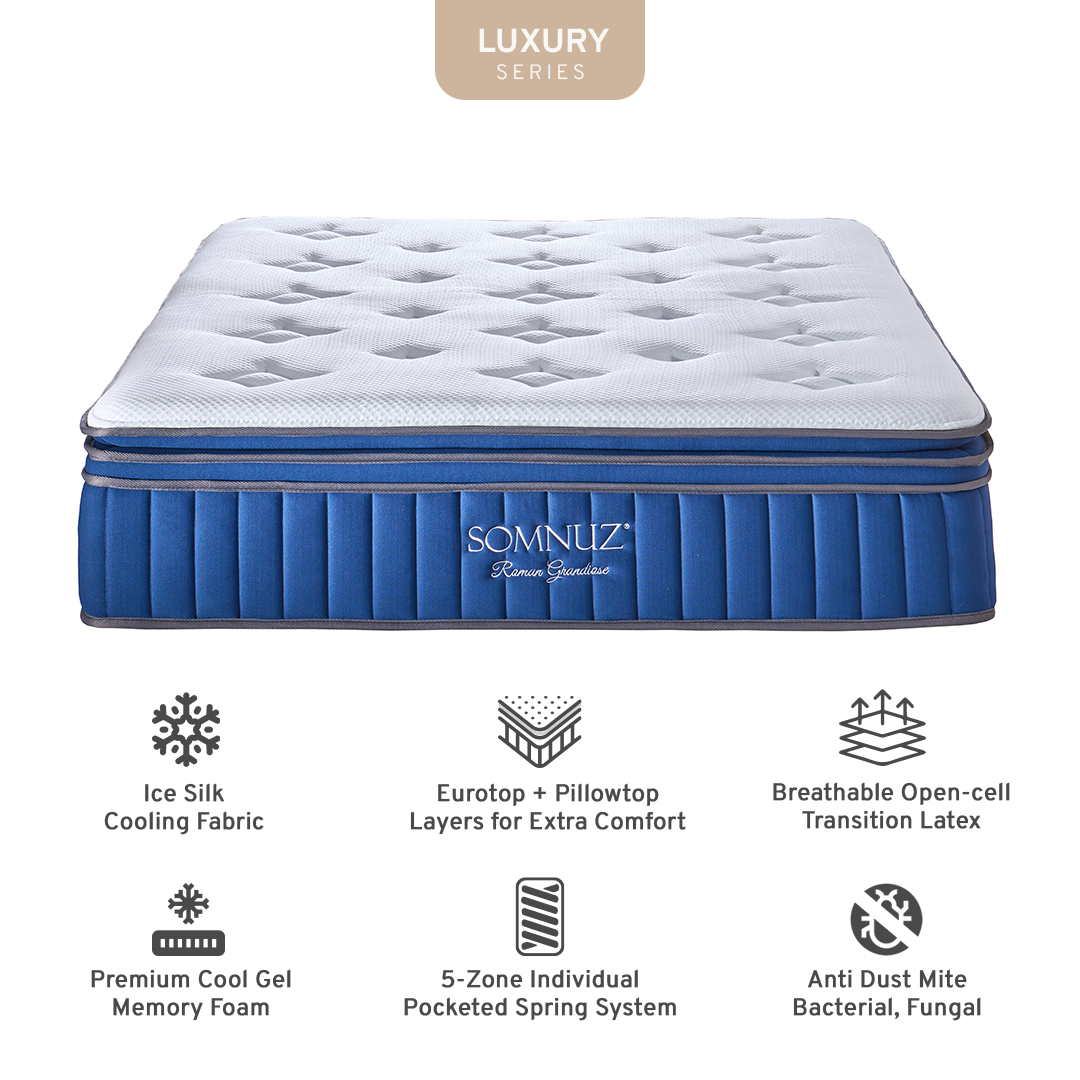
The Somnuz pocketed spring mattresses are built on this principle. The spring core provides adaptive support across different zones while the comfort layer above manages surface feel without sacrificing structural integrity. For back pain specifically, the Somnuz Comforto Latex Pocketed Spring Mattress adds a latex comfort layer which is buoyant and supportive, exactly the kind of surface that helps the lumbar region stay in position overnight.
How to Test Whether a Firmness Level Works for You
The most practical test is to lie in your usual sleeping position for at least five to ten minutes on the mattress you are considering. In that position, someone looking at you from the side should not see your spine obviously bowed upward or downward. Your lower back should feel supported, not hanging in space and not pressed upward by a rigid surface.
If possible, buy from a retailer that offers a sleep trial. A showroom test tells you something, but sleeping on a mattress for several nights in your own home tells you much more about whether it suits your back.
If Your Current Mattress Is Too Soft
If you suspect a soft, worn-out mattress is contributing to your back pain but you are not ready to replace it, a firmer mattress topper is not the solution. A topper sits on top of the existing mattress and follows its contours. It cannot fix the underlying softness or body impressions.
Replacement is the only real fix when the mattress core has given out. The full Somnuz collection covers options across different firmness levels in pocketed spring, foam, and latex. For a clearer comparison across build quality, the Premium Series covers mid-range options that balance support, durability, and breathability.
Final Thoughts
A hard mattress is not the universal solution for back pain it was once assumed to be. For most sleeping positions and body types, a medium-firm mattress that accommodates the spine's natural shape while resisting excessive sinkage is a better choice. Firmness needs vary by sleeping position, body weight, and the specific nature of the back problem. Testing before buying, using a sleep trial where possible, and focusing on construction quality rather than just the firmness label will lead to a better outcome than defaulting to the hardest option available.